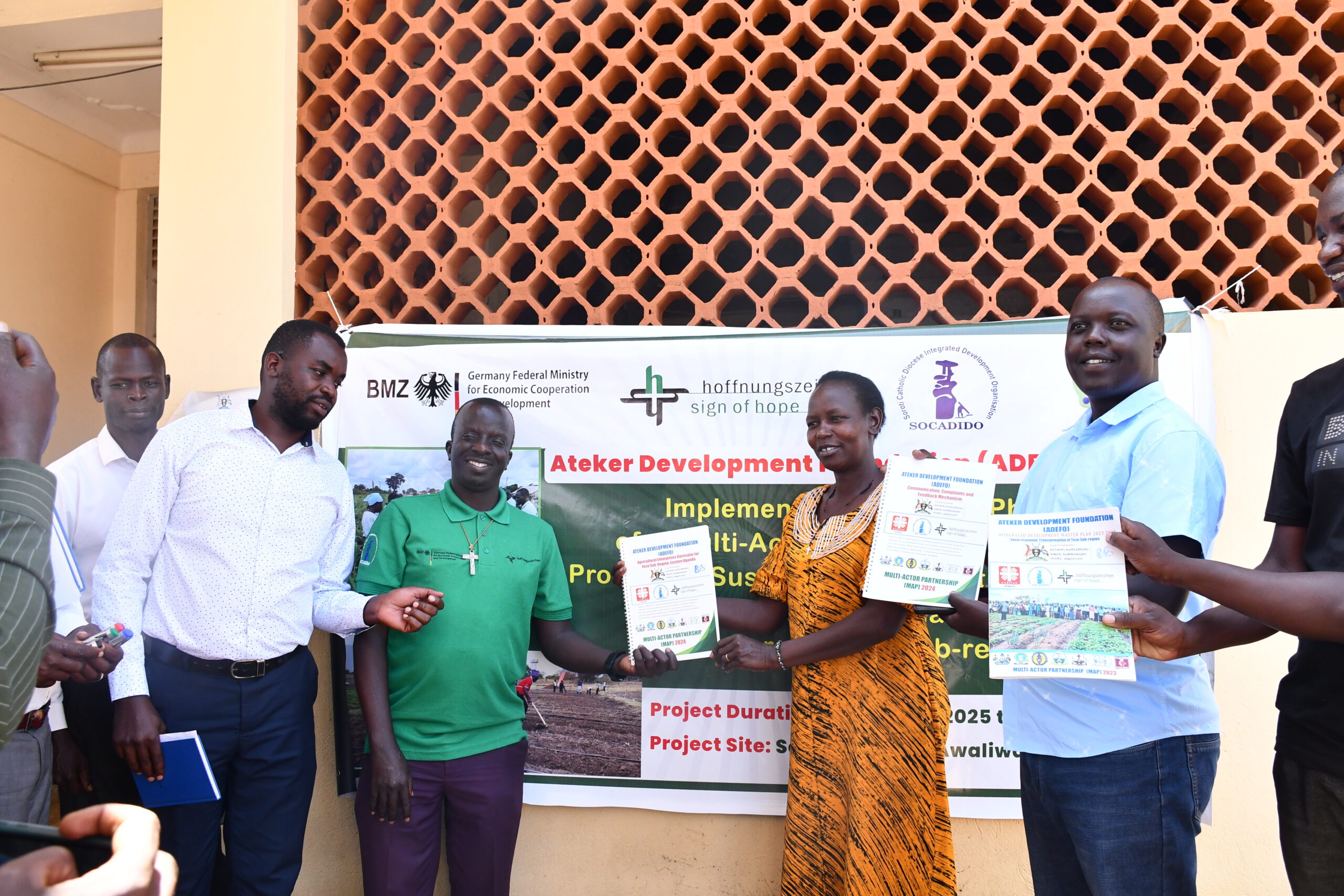
Leaders in Soroti district have called for a fundamental mindset shift toward commercial farming following the official roll out of the Ateker Development Foundation Multi-Actor Partnership (ADEFO-MAP2) project.
The initiative is spearheaded by Ateker Development Foundation (ADEFO) through its implementing partner Soroti Catholic Diocese Integrated Development Organization (SOCADIDO). The four-year project aims to promote sustainable agriculture and value chains, enhance value addition, and improve livelihoods for smallholder farmers across the Teso sub-region.
The Soroti district Launch, brought together political leaders, district technocrats, extension workers, civil society organizations, and farmers from Awaliwal and Ocokican sub-counties.
Speaking at the launch, Assistant Resident District Commissioner Mr. Mutai Victor pledged full district cooperation. “We welcome our development partners and promise to work with you to ensure the success of this project,” he said.
Mutai emphasized that agriculture must be viewed as a business rather than a subsistence activity. He also challenged men to re-engage in agriculture, questioning why farming has largely been left to women despite its economic potential.
With the rainy season approaching, he urged extension workers to lead the charge in transforming community perceptions. “Men must be told that farming is business. Something must be done about this mindset.”
Jessica Florence Akiteng, District Woman Councillor for Aukot Sub-county and Secretary for Production and Natural Resourcesin the district, said, “We worked together in Phase I, and now again we have come together for Phase II. I can already see that our farmers have progressed.”
She noted improvements in farmer knowledge, farm management practices, and value chain engagement from the first phase. She also appealed for expansion of the program to additional sub-counties.
According to ADEFO-MAP Coordinator Ben Boham Okiror, Phase II will run from November 1, 2025, to October 31, 2029. The project is funded by Sign of Hope (SoH) and the German Federal Ministry for Economic Cooperation and Development (BMZ).
The initiative seeks to transition agriculture from subsistence to a profitable, market-oriented enterprise.
A feasibility study conducted by ADEFO identified major challenges facing farmers:
- Over 95% of the population engaged in agriculture, largely at subsistence level.
- Structural food insecurity and multidimensional poverty affecting 56% of households.
- Heavy reliance on rain-fed agriculture amid erratic rainfall.
- Pests, diseases, and post-harvest losses estimated at 30–40%.
- Weak market access and low bargaining power.
Moses Esatu, Principal Assistant Secretary for Soroti district, emphasized the importance of local ownership. “We must own this project. Even if tomorrow SOCADIDO withdraws, the district must be able to take over.”He urged participants to serve as information ambassadors in their communities, ensuring knowledge transfer beyond the launch event.
Meanwhile, Richard Ocen of HealthNeed Uganda, a member of ADEFO called for stronger accountability systems, advocating for a comprehensive farmer and enterprise database accessible both physically and online.
As a sub-county leader, Peter Ebau, the LCIII Chairperson for Awaliwal Sub-county, pledged local government support while urging inclusion of farmers who may not have benefited previously.
Phase II implementation in Awaliwal and Ocokican sub-counties will rely on coordinated efforts among extension workers, parish chiefs, political leaders, and farmer groups.
District leaders agree that success of the project will hinge on:
- Mindset transformation
- Quality production standards
- Stronger market linkages
- Inclusive participation
So nice.
Are there some vacancies available in agriculture